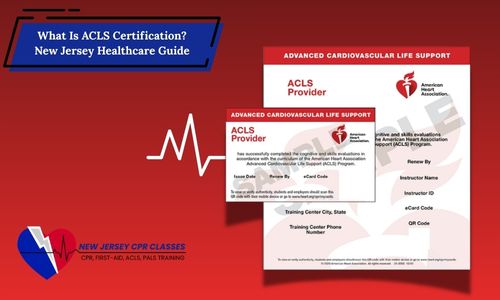
ACLS certification, short for Advanced Cardiovascular Life Support, is the American Heart Association credential that prepares healthcare providers to manage a cardiac arrest or other life-threatening cardiovascular emergency from start to finish. It covers airway management, rhythm recognition, medications, and team leadership skills needed once a resuscitation moves past its first few minutes.
If you work in a New Jersey emergency department, ICU, or surgical unit, chances are ACLS certification is already sitting on your list of job requirements. This guide covers exactly what the course involves, who needs it in New Jersey, and how to get certified without disrupting your work schedule.
What Does ACLS Certification Actually Cover?
ACLS certification teaches providers how to recognize and respond to cardiac arrest, unstable arrhythmias, and other cardiovascular emergencies as part of a coordinated team. The course covers several core areas:
- Recognizing and interpreting cardiac rhythms on an ECG, including which rhythms call for immediate defibrillation and which don’t
- Managing airways with tools beyond a basic bag mask, including supraglottic devices and advanced airway techniques
- Administering the medications used during resuscitation, including when and why each one is given
- Leading or supporting a resuscitation team, with clear roles, closed-loop communication, and coordinated timing during a code
- Applying post-cardiac arrest care principles once a patient regains a pulse
The course also spends real time on team dynamics. A cardiac arrest response rarely goes smoothly when everyone is talking over each other or unsure who’s doing what. ACLS trains providers to communicate clearly under pressure, assign roles quickly, and keep a resuscitation moving without confusion.
Who in New Jersey Needs ACLS Certification?
ACLS requirements in New Jersey generally come from employers and hospital credentialing offices rather than a single statewide licensing rule, though it does show up directly in state regulation for certain EMS roles.
Nurses: The New Jersey Board of Nursing does not require ACLS for RN licensure itself. Hospitals set that requirement instead, and it’s a near-universal expectation for nurses working in emergency departments, intensive care units, cath labs, and surgical services across the state.
Physicians, PAs, and NPs: Hospital credentialing committees at New Jersey medical centers typically require active ACLS for physicians and advanced practice providers working in emergency medicine, critical care, anesthesia, and related high-acuity specialties.
EMTs and paramedics: New Jersey state regulation formally defines ACLS certification as a credential issued by the American Heart Association, and paramedics operating under advanced life support protocols are expected to hold it as part of their scope of practice.
Nursing and medical students: Students heading into clinical rotations within critical care or emergency settings are often asked to bring ACLS current later in their training.
If your day-to-day role doesn’t involve responding to codes directly, such as outpatient clinic work or general floor nursing in a lower-acuity unit, you likely won’t need ACLS unless your specific employer says otherwise.
Does New Jersey Accept Online-Only ACLS Certification?
No. New Jersey healthcare employers and credentialing bodies consistently require a hands-on skills component for any ACLS certification used in clinical practice. A fully online course with no in-person or supervised skills verification generally isn’t accepted for employment or hospital credentialing purposes in the state.
This is where a blended format matters. Completing the cognitive portion online and then attending a skills session gives you the flexibility of self-paced learning while still meeting the hands-on requirement New Jersey employers expect to see on your certification record.
How New Jersey CPR Classes Structures ACLS Training
At New Jersey CPR Classes, we built our ACLS course around how healthcare professionals actually manage their time. Instead of pulling you into a full-day classroom session, our Self-Guided Learning format lets you complete the cognitive coursework online, at your own pace, around shifts, clinicals, or family responsibilities.
Once you finish the online portion, you’ll come in for a short hands-on skills session at one of our CPR Verification Stations. There, you’ll work through cardiac arrest scenarios on a Voice-Assisted Manikin that gives you real-time feedback on compression depth, rate, and technique. This isn’t a passive skills check. It’s built to mirror the pace and pressure of a real resuscitation, so you leave with the same confidence you’d expect from a full in-person course.
For hospitals, EMS agencies, and healthcare organizations, we also offer CPR Verification Station rentals for on-site group certification. Rather than scheduling staff out individually, bring ACLS renewal in-house for your entire department or unit, on a timeline that works around your operations.
How Often Does ACLS Certification Need to Be Renewed?
ACLS certification through the AHA is valid for two years from your completion date. Renewal typically involves a condensed review of core content followed by a skills assessment, rather than repeating the entire initial course. Letting your certification lapse can create real problems for New Jersey providers, including losing shift eligibility, failing a credentialing audit, or being pulled from patient care duties until it’s resolved.
Scheduling your renewal a few weeks ahead of your expiration date, rather than after your card has already lapsed, keeps you compliant without any gap in your ability to work.
Getting Started With ACLS Certification in New Jersey
If ACLS is a requirement for your current role or one you’re moving into, the most efficient path is to enroll in an AHA-approved ACLS course that includes a real hands-on skills component, since that’s what New Jersey employers and credentialing offices consistently expect to see.
At New Jersey CPR Classes, we handle that in a format built around a working healthcare professional’s schedule. Complete your Self-Paced CPR Certification online, then finish with a skills session at a CPR Verification Station near you. You’ll walk away with a credential that satisfies New Jersey employer requirements and skills you can actually rely on during a real emergency.
Frequently Asked Questions
Is ACLS certification required by the New Jersey Board of Nursing?
No. The Board doesn’t mandate ACLS for RN licensure. Individual hospitals and healthcare employers set this requirement, and it’s standard for nurses in emergency, ICU, and surgical settings.
Can I complete ACLS certification fully online in New Jersey?
Not for clinical practice. New Jersey employers and credentialing bodies require a hands-on skills verification component, so a fully online course without an in-person skills check typically won’t meet employment requirements.
How long is ACLS certification valid?
ACLS certification through the AHA is valid for two years from your completion date, after which a renewal course is required.
Does ACLS certification cover pediatric patients?
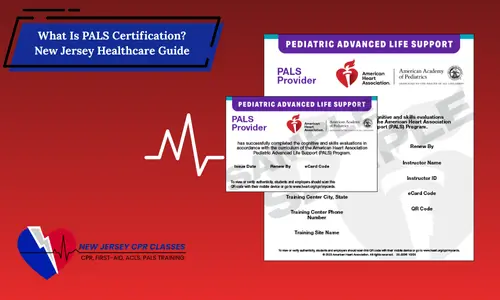
ACLS is focused on adult cardiovascular emergencies. Providers who need pediatric-specific training should ask about a separate certification built for infants and children.