Nurses working in hospitals, outpatient clinics, long-term care facilities, and other healthcare settings are often expected to maintain current Basic Life Support (BLS) certification. Nursing students may also need an active BLS completion card before beginning clinical rotations.
For nurses in New Jersey, understanding which certification to obtain, when to renew it, and what employers expect can prevent problems during hiring, onboarding, and clinical placement. However, BLS certification requirements are not necessarily the same for every nursing position or educational program.
This guide explains BLS certification for nurses in New Jersey, including the role of the New Jersey Board of Nursing, employer expectations, course requirements, renewal, and available training options.
Do Nurses Need BLS Certification in New Jersey?
Yes, many nurses in New Jersey need current BLS certification to meet their employer’s requirements or their nursing school’s clinical placement policies. However, this should not be confused with a universal state nursing licensure requirement.
The distinction matters. A nursing license issued by the New Jersey Board of Nursing establishes a person’s legal authority to practice within the applicable scope of nursing practice. BLS certification demonstrates that a person has completed training in basic cardiovascular life support skills.
Hospitals and other healthcare organizations may establish their own training requirements for employees. Nursing schools may also require students to maintain an active BLS completion card before participating in clinical experiences.
The specific requirement depends on the position, workplace, educational program, and applicable policies. Nurses should confirm which course and training provider their employer or school accepts before registering.
What Does BLS Certification Cover for Nurses?
Basic Life Support is a healthcare-focused training program that prepares participants to respond to cardiac arrest, respiratory emergencies, and other life-threatening situations.
The American Heart Association (AHA) BLS Provider Course focuses on recognizing emergencies, performing high-quality CPR, using an automated external defibrillator (AED), and working effectively with other healthcare professionals during resuscitation.
For nurses, the training covers several practical skills.
1. High-Quality CPR for Adults, Children, and Infants
Participants learn how to perform CPR on different age groups. Training includes proper chest compression technique, appropriate compression depth and rate, complete chest recoil, and minimizing interruptions.
Nurses also practice providing effective rescue breaths and ventilations using appropriate techniques and equipment.
2. AED Operation
An automated external defibrillator analyzes a person’s heart rhythm and determines whether an electrical shock is advised.
BLS training teaches nurses how to:
- Recognize when an AED is needed.
- Apply the AED pads correctly.
- Follow the device’s voice and visual instructions.
- Deliver a shock when advised.
- Resume CPR promptly after the shock or when no shock is advised.
3. Team-Based Resuscitation
Cardiac emergencies in healthcare facilities often involve multiple responders. Nurses need to communicate clearly, coordinate tasks, and work with other members of the healthcare team.
BLS training addresses effective team dynamics, role assignment, communication, and coordination during resuscitation.
4. Choking and Airway Obstruction
The course also covers recognizing and responding to foreign-body airway obstruction in adults, children, and infants.
Participants learn the appropriate response techniques for different age groups and how to recognize when a person requires additional emergency assistance.
These skills are relevant to nurses working in emergency departments, medical-surgical units, outpatient settings, and other patient care environments.
Which Nurses in New Jersey Should Have BLS Certification?
BLS certification is relevant to many nursing roles, although the exact requirement depends on the employer, position, and work environment.
Registered Nurses (RNs)
Registered nurses working in hospitals, urgent care centers, outpatient facilities, and other clinical environments may be required to maintain an active BLS Provider completion card.
Hospital-based RNs frequently encounter situations where they must recognize cardiac or respiratory deterioration and respond as part of a clinical team.
Licensed Practical Nurses (LPNs)
LPNs working in nursing homes, rehabilitation centers, assisted living facilities, and home healthcare may also need current BLS certification.
Employers can specify the required course, accepted training organization, and renewal schedule as part of their employment policies.
Nursing Students
BLS certification is particularly relevant to nursing students preparing for clinical rotations.
Students should check their program’s requirements before registering because some schools accept only specific training providers.
Advanced Practice Nurses (APNs)
Advanced Practice Nurses may need BLS certification depending on their specialty, employer, and clinical responsibilities.
An APN working in an acute care environment may have different training requirements from someone working primarily in a nonclinical or administrative position.
Is BLS Certification Required by the New Jersey Board of Nursing?
This is one of the most common questions among nurses researching BLS certification in New Jersey.
The New Jersey Board of Nursing regulates nursing education, professional licensure, and nursing practice under the New Jersey Nurse Practice Act and applicable administrative regulations.
The Board’s published nursing regulations address licensure requirements, nursing education, professional conduct, and other aspects of nursing practice. They do not list an AHA BLS Provider completion card as a general requirement for obtaining or renewing an RN or LPN license.
This distinction is worth understanding:
- State licensure: Requirements established by the New Jersey Board of Nursing for legal authorization to practice.
- Employer requirements: Training and credentials required by a hospital, healthcare facility, or staffing agency.
- Educational requirements: Certifications required by a nursing school or clinical placement program.
A nurse can meet the state’s nursing licensure requirements and still need to obtain or renew BLS certification to satisfy an employer’s policies.
Before enrolling in a course, check the specific requirements of your workplace or educational program. Do not assume that a state nursing license automatically satisfies an employer’s CPR training requirements.
What Type of BLS Certification Should Nurses Choose?
Nurses should generally look for an American Heart Association BLS Provider course intended for healthcare professionals.
The AHA offers BLS training in different formats. The learning format may vary, but students must complete the required course components to receive the appropriate course completion card.
Here is a comparison of the main options.
| Training format | How it works | Best suited for |
| Classroom training | Complete the course with an instructor, including skills practice and testing. | Nurses who prefer traditional classroom instruction. |
| Blended learning | Complete online coursework followed by an instructor-led skills session. | Nurses who want to complete the learning portion online. |
| Self-Guided Learning | Complete online coursework followed by hands-on skills verification at an approved CPR Verification Station. | Nurses who prefer independent learning and a self-guided skills process. |
The AHA recognizes these as different training delivery methods. Nurses should confirm that the selected format meets their employer’s requirements before registering.
Is an Online BLS Course Enough for Nurses?
Not necessarily.
Completing an online course alone does not automatically satisfy the requirements for an AHA BLS Provider completion card.
For courses involving online learning, participants must also complete the required hands-on skills component through the applicable training format.
AHA HeartCode BLS combines online coursework with a hands-on skills session. Self-Guided Learning uses a CPR Verification Station for the skills portion.
This distinction is important when selecting a course. Nurses should avoid enrolling in a general online CPR class if their employer specifically requires an AHA BLS Provider completion card.
How to Get BLS Certification in New Jersey
Nurses who need an AHA BLS Provider completion card can complete their training through an authorized AHA training provider.
New Jersey CPR Classes, powered by Same Day CPR, offers BLS training through online coursework and hands-on skills verification at local CPR Verification Stations.
The process generally involves three steps.
Step 1: Complete the Online Coursework
Start by completing the required online BLS coursework. The learning materials cover CPR techniques, AED operation, airway obstruction, and team-based resuscitation.
You can work through the course material at your own pace before scheduling your skills session.
Step 2: Attend a CPR Verification Station
After completing the online portion, visit your selected CPR Verification Station to complete the hands-on skills component.
The station uses a Voice-Assisted Manikin to provide audio and visual feedback during CPR practice and skills verification.
You will demonstrate the required skills and receive feedback based on your performance. The self-guided format allows you to work through the required skills process without a traditional classroom session.
Step 3: Receive Your AHA BLS Provider eCard
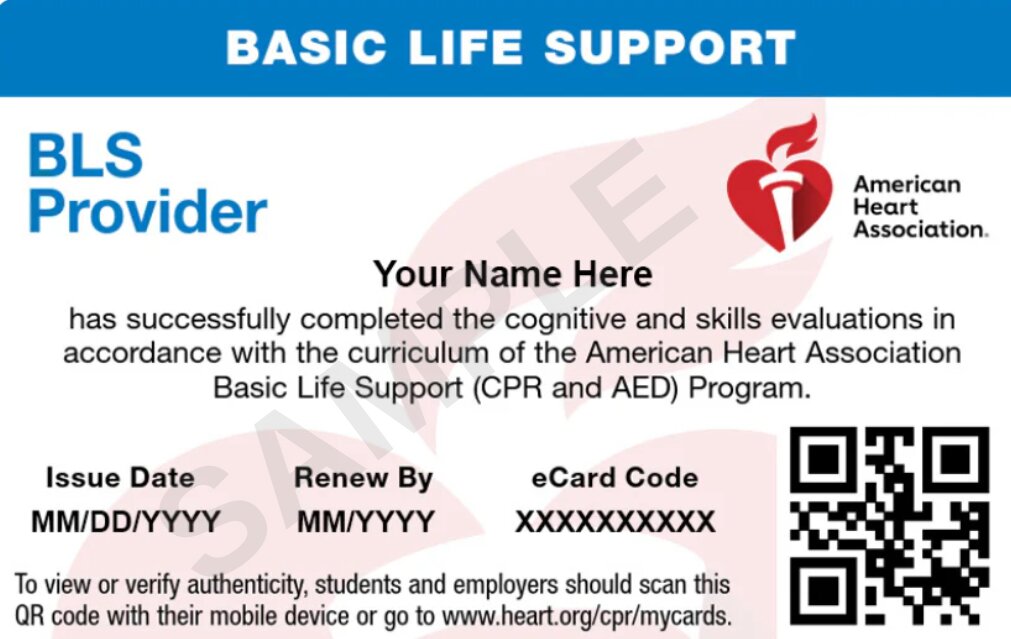
Once you successfully complete all required course components, you receive an American Heart Association BLS Provider Course Completion eCard.
The eCard serves as proof that you have completed the course requirements. You can provide it to your employer, nursing school, or clinical placement coordinator when requested.
New Jersey CPR Classes offers training locations across the state, including Newark, Jersey City, Princeton, Morristown, Cherry Hill, Somerset, and other communities.
You can explore available locations through the New Jersey CPR training locations directory.
How Long Is BLS Certification Valid for Nurses?
An American Heart Association BLS Provider Course Completion Card is valid for two years.
Nurses should check the expiration date on their eCard and arrange renewal before it expires.
For example, if your BLS completion card expires in September, it is sensible to plan your renewal ahead of that date rather than waiting until the last few days.
This is particularly important for nurses who need to submit updated credentials for:
- Hospital employment or onboarding.
- Annual or periodic employee credential reviews.
- Travel nursing assignments.
- Clinical placements and nursing education programs.
Some employers may have specific deadlines for submitting updated certification documents. Follow those deadlines even if your existing completion card has not yet expired.
How Often Should Nurses Renew BLS?
The AHA BLS Provider completion card has a two-year validity period. Nurses generally need to complete the appropriate renewal training before the expiration date to maintain an active credential.
Before registering, check whether your employer requires an initial course or a renewal course.
If your previous card has expired, do not assume that you qualify for renewal training. Confirm the appropriate course with your training provider and employer.
You should also verify whether your workplace requires an AHA course specifically or accepts other recognized training organizations.
BLS vs. ACLS: Which Certification Do Nurses Need?
BLS and Advanced Cardiovascular Life Support (ACLS) are different courses. They cover different levels of resuscitation knowledge and clinical response.
Some nurses need BLS only, while others may be expected to maintain both certifications.
| Feature | BLS | ACLS |
| Full name | Basic Life Support | Advanced Cardiovascular Life Support |
| Training level | Foundational life support | Advanced cardiovascular emergency management |
| Main focus | CPR, AED use, ventilation, and team response | Recognition and management of advanced cardiovascular emergencies |
| Intended audience | Healthcare professionals and other qualified personnel | Healthcare professionals involved in managing advanced cardiovascular emergencies |
| Validity | 2 years | 2 years |
BLS is generally the starting point for nurses who need healthcare-provider CPR training.
ACLS covers more advanced topics, including cardiac arrest management, cardiac arrhythmias, acute coronary syndromes, stroke, and post-cardiac arrest care.
A nurse working in an emergency department, intensive care unit, or another acute care environment may be required to hold both credentials. However, this depends on the employer and position.
An AHA BLS completion card does not automatically qualify someone for ACLS, and holding ACLS does not eliminate an employer’s separate BLS requirements.
If you are unsure which course to take, check your job description or contact your facility’s education or credentialing department.
Where Can Nurses Get BLS Certification in New Jersey?
Nurses can obtain BLS training through authorized AHA training providers, hospital education departments, and other recognized training organizations.
The right option depends on your location, schedule, and employer’s certification requirements.
New Jersey CPR Classes provides BLS training through its network of CPR Verification Stations across New Jersey.
The training process combines online learning with a hands-on skills session at the selected CPR Verification Station.
Visit the New Jersey CPR Classes location directory to find a nearby station.